

Best TaC Coated Susceptor for Reliable Semiconductor Manufacturing
2026-11-16
Every degree of thermal drift in an MOCVD chamber can quietly erode wafer uniformity—and with it, yield. That is why the choice of susceptor coating is far from a minor detail. As epitaxial processes push toward tighter tolerances, tantalum carbide coated susceptors have moved from niche upgrade to essential infrastructure. In this post, we look at what separates a genuinely reliable TaC coated susceptor from the rest, and how Semicorex is helping fabs hold the line on repeatable film quality.
Why Uncoated Graphite Rarely Survives Aggressive Process Chemistries
Graphite looks tough on paper. Its layered carbon structure holds up under extreme heat, it machines easily, and it resists thermal shock better than most ceramics. But drop it into a hot acid leach, a chlorinating roast, or a fluoride-bearing electrolyte, and that confidence evaporates. The problem isn't the carbon itself so much as the open porosity and the reactive edge sites between the basal planes. Aggressive chemistries don't need a crack to get in; they wick through the pore network and start peeling the structure apart from the inside.
Once oxidation or intercalation begins, the damage accelerates in ways that aren't always obvious from the outside. A graphite crucible can look intact after a week in a sulfate roast, yet lose half its mechanical strength because the binder phase has been selectively attacked. In halogen-rich streams, volatile metal halides form inside the pores and then expand on heating, spalling off chunks of the working surface. Even the most carefully densified grades fall short because uncoated graphite always presents the same vulnerable interface: raw carbon in direct contact with whatever wants to react with it.
Coatings exist for a reason, and it isn't just marketing. A dense, chemically inert barrier can shut down the wicking path and keep the binder from becoming a sacrificial weak point. Without that layer, the graphite is essentially a high-temperature sponge holding its shape until the chemistry decides otherwise.
How TaC Coatings Hold Up Under Rapid Thermal Cycling
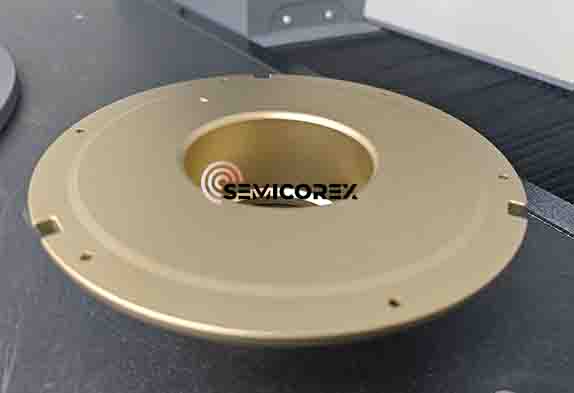
Tantalum carbide coatings face a brutal test when temperatures swing from ambient to several hundred degrees in seconds. Most hard coatings crack or delaminate under that kind of shock, but TaC manages to hold together because its coefficient of thermal expansion sits remarkably close to graphite. That similarity reduces the stress that builds at the interface during each cycle, so microcracks don't get a chance to spread the way they would with other carbides.
Repeated rapid cycling does leave its mark, though. The surface often develops a fine network of shallow fissures after dozens of cycles, but these remain superficial and rarely penetrate into the substrate. In practical terms, that means a TaC-coated susceptor or crucible can survive hundreds of heating and cooling events without losing its protective function. The coating may look tired under a microscope, yet it continues to shield the underlying graphite from oxidation and erosion.
What sets TaC apart is the way it accommodates strain gradually. Instead of failing catastrophically at a single stress point, the coating distributes thermal stress across a broad area, then relaxes it during the cooling phase. This self-relieving behavior is the main reason engineers keep returning to TaC for processes like MOCVD or epitaxy, where fast ramp rates and extreme peak temperatures are routine.
Particle Performance Without Extra Chamber Wipes or Plasma Cleans
Achieving low particle counts in a process chamber has traditionally demanded frequent manual wiping or supplemental plasma cleans. This system sidesteps that burden by managing particle generation at the source: gas delivery paths, lift pin motion, and wafer transfer clearances are tuned so that contact events release fewer particulates into the chamber environment. As a result, baseline defect density stays flat across extended runs without adding cycle time for maintenance.
The real difference shows up in mixed-recipe production. Rather than relying on a periodic plasma clean to recover from drift, the chamber retains a narrow particle distribution across varying temperatures, pressures, and film stacks. That means fewer interruptions, less consumable wear, and a cleaner baseline between scheduled wet cleans—without asking operators to add wipes or plasma steps to an already packed production day.
The Link Between Susceptor Flatness and Film Thickness Uniformity
In deposition chambers, the susceptor does more than hold a wafer in place. It defines the local gap between the wafer backside and the heated pedestal surface, which directly shapes how heat transfers into the wafer and how process gases flow across the front side. Even a small deviation in flatness across the susceptor can alter the thermal boundary layer, creating pockets where the wafer runs slightly hotter or cooler. Those temperature offsets show up later as thickness variation because most film-forming reactions are strongly temperature dependent.
When a susceptor warps or develops uneven wear, the wafer no longer sits in full contact with the surface. The resulting micro-gaps change the local heat path and can also disturb gas velocity near the wafer edge. In metal-organic chemical vapor deposition and plasma-enhanced processes, this often appears as a radial non-uniformity or a crescent-shaped defect pattern that shifts with susceptor rotation. The film may be within specification at the center but drift out of tolerance near one side, which is a signature of mechanical flatness loss rather than a gas distribution problem.
Regular flatness mapping is therefore more than a maintenance check. By measuring the susceptor with a dial indicator or optical profilometer after each preventive maintenance cycle, process engineers can catch curvature before it translates into yield loss. Correcting flatness through resurfacing, re-torquing, or replacing the susceptor often restores film uniformity without changing the recipe, making it one of the most direct ways to keep thickness variation within a narrow process window.
Managing Thermal Stress in Larger Wafer Formats
Larger wafer formats push every thermal step closer to its physical limits. The wider surface area does not heat or cool uniformly, so local expansion and contraction create stress gradients that were barely noticeable on smaller diameters. A ramp profile that worked for 200 mm often leads to edge slip or warpage on 300 mm and beyond. This forces process engineers to rethink not just peak temperatures, but how long each zone stays within a dangerous differential window.
One practical shift is moving away from single-zone control assumptions. Multi-zone furnaces and rapid thermal processing chambers now rely on real-time temperature mapping across the wafer. By adjusting heater outputs independently, they can hold the center-to-edge difference tight enough to avoid dislocation generation. Materials also matter: growing thicker epi layers or using engineered backside films can redistribute stress more evenly, though these add cost and must be weighed against yield loss from cracked or bowed wafers.
Thermal stress management becomes less about hitting a recipe number and more about controlling the transient. The moments right after a fast ramp, or during cool-down, often cause more damage than the soak itself. Inline metrology for bow and warp, placed immediately after furnace or RTP steps, helps catch stress-related deviations before they propagate into lithography overlay errors later. For larger formats, that early feedback loop is what keeps a thermal process viable instead of just theoretically uniform.
What Production Data Says About Maintenance Intervals and Coating Life
Maintenance teams often rely on supplier datasheets for recoating schedules, but actual production logs rarely match those generic timelines. When thickness readings, visual inspection notes, and process conditions are pulled together, a clearer pattern emerges: coating life is driven less by calendar age and more by localized stress. Tanks and pipe racks exposed to frequent thermal cycles or abrasive dust tend to show measurable film loss years before identical equipment in quieter areas.
Several plants that track coating condition alongside production data have found that a uniform interval wastes both material and labor. For example, a five-year recoat cycle may be too early for 60 percent of the asset list while a handful of high-wear zones already need touch-up by year three. Using corrosion coupons, dry film thickness trends, and failure records makes it possible to assign intervals by service type rather than asset class alone.
The most useful production data is not complicated. It includes where coatings fail first, how often the equipment runs beyond normal temperatures, and whether surface preparation was documented. Those observations allow planners to stretch budgets where coatings are still intact and direct crews to the areas that actually degrade. Over time, this shifts the conversation from fixed schedules to condition-based recoating.
FAQ
TaC holds up better in ammonia and hydrogen at temperatures where SiC starts to react and roughen. The TaC surface remains denser and less catalytic, so it adds fewer particles to the chamber and keeps the graphite underneath sealed off for a longer run life.
CVD-applied TaC tends to produce a conformal, low-stress film with a consistent grain structure. That uniformity matters because cracks usually begin at weak spots or thickness transitions. A well-deposited layer survives repeated thermal cycling without exposing raw graphite.
The surface finish directly affects gas flow and heat transfer at the wafer. A controlled roughness level reduces micro-turbulence around the pocket and evens out the boundary layer, which translates to better film thickness uniformity across the wafer.
In many cases it can be recoated. The graphite core needs to be inspected for oxidation damage and dimensional drift first. After stripping the old coating without attacking the graphite, a fresh CVD TaC layer can be applied to restore the part to production condition.
Shifts in pyrometer readings under stable heater power, a rising particle count on monitor wafers, or visible dull patches and pinholes on the surface are typical indicators. Any of these mean the coating may be thinning or losing adhesion in localized areas.
No. Thicker coatings can develop higher internal stress during heating and cooling cycles. The dependable approach is to match the thickness to the reactor's thermal profile so the coating stays intact under stress while still giving enough chemical protection.
When the coating stays intact and dimensionally stable, the chamber requires less frequent cleaning, and the susceptor does not need to be changed as often. That reduces the number of times the tool is opened and shortens the time spent bringing the environment back to a controlled state.
Purity, density, and thermal expansion compatibility with the graphite core matter most. Any metal impurity can end up in the epitaxial layer, while a mismatch in expansion behavior will eventually cause microcracks. The best films are pure, dense, and controlled enough to avoid both problems.
Conclusion
Graphite susceptors fail quickly once exposed to halogen-based etch chemistries and high-temperature metalorganic precursors. The unprotected surface erodes, releases carbon particles, and forces frequent chamber cleans. A TaC coating changes that failure mode: it blocks reactive gas attack, keeps the graphite substrate intact, and preserves carrier flatness across hundreds of cycles. In rapid thermal processing, that flatness is not cosmetic. Local warpage alters gas flow and temperature distribution, so film thickness drifts across the wafer. With TaC, the coefficient mismatch is managed well enough to reduce bowing and edge roll-off on 200 mm and 300 mm formats, even when heaters ramp aggressively.
Production logs from wafer fabs show a different maintenance pattern once TaC susceptors are installed. Particle counts stay low without adding chamber wipes or plasma cleans, and unplanned downtime tied to susceptor replacement drops. The coating life is less about a fixed number of runs and more about process conditions: high chlorine or fluorine loads shorten it, moderate thermal cycles extend it. Still, the data consistently points to longer intervals than uncoated graphite. For reliable semiconductor manufacturing, the practical advantage is a susceptor that keeps its dimensions, sheds less material, and avoids turning a consumable into a hidden source of yield loss.
Contact Us
Contact Person: Svenja Wei
Email: [email protected]
Tel/WhatsApp: +8613567891907
Website: https://www.semicorex.com