

How Do Tire Knobs Affect Traction on Loose Soil and Rocks
2026-03-19
When riding off-road, the only contact between a motorcycle and the terrain is the small surface area of the Off Road Motorcycle Tires. For riders navigating loose soil and rocky inclines, the design of the tire knob is the defining factor between conquering a trail and losing control. At JABIL, we understand that traction is not just about rubber; it is a science of physics and pattern engineering. The knobs are designed to dig, flex, and release debris to maintain a continuous grip. Understanding this mechanism is crucial for any rider looking to improve their safety and performance on unpredictable surfaces.
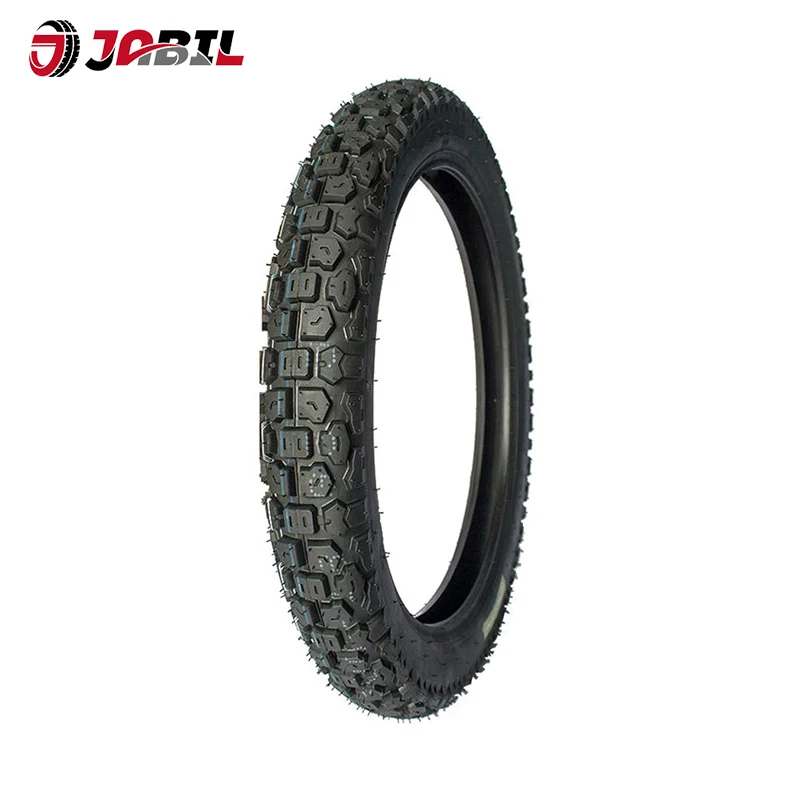
The Mechanical Function of Knobs on Soft Terrain
On loose soil, a tire needs to penetrate the surface to find solid ground. Taller, more spaced-out knobs act like paddles. As the wheel rotates, the knobs dig into the dirt, creating horizontal shear force that propels the bike forward. If the knobs are too close together (commonly referred to as a "paddle" effect), the soil packs between them, turning the tire into a slick racing slick. JABIL Off Road Motorcycle Tires utilize a variable spacing pattern to ensure that soil is shed continuously, allowing the knobs to bite into fresh dirt with every rotation.
Knob Dynamics on Rocky Surfaces
Rocks present a different challenge compared to soil. While soil requires penetration, rocks require conformability and edge grip. When a tire contacts a rock, the knob must deform slightly to maximize the contact patch. Softer compound knobs will wrap around the rock, while harder compounds might slide off.
However, the shape of the knob matters significantly. Square-edged knobs provide a biting effect on rock edges, but they can also fold over under hard braking. JABIL engineers multi-directional support structures in their knobs to prevent this "fold-over," ensuring that the tire maintains stability even when the terrain is as hard as granite.
Knob Height vs. Stability
There is a direct trade-off between depth and stability. The table below illustrates the functional differences based on knob geometry:
| Knob Characteristic | Benefit on Loose Soil | Benefit on Rocks | Potential Drawback |
|---|---|---|---|
| Tall Knobs (12mm+) | Deep bite into soft loam; excellent forward traction. | Wraps around larger rocks for grip. | Feels "wiggly" or unstable on hard-pack; flexes too much. |
| Short Knobs (<10mm) | Limited penetration; poor in deep soil. | Stable platform; precise steering on rock. | Harsh ride; lacks cushioning on sharp edges. |
| Wide Spacing | Self-cleaning; prevents mud packing. | Reduces risk of "ballooning" over rocks. | Can vibrate at high speed on hard surfaces. |
| Narrow Spacing | Smooth transition; good for flat tracking. | Continuous contact on flatter rocks. | Quickly clogs in sticky adobe mud. |
The Role of Knob Stiffness and Support
The rubber compound is half of the equation, but the physical support structure of the knob is the other half. When a knob hits a rock, the force isn't just downward; it is rearward and sideways. If the base of the knob is too narrow, it will squirm excessively, making the bike feel vague and unstable. High-quality Off Road Motorcycle Tires like those from JABIL feature a "bridge" or "gusset" system between the center knobs. This connects the knobs structurally, allowing them to act as a unified block under acceleration but separate enough to dig in when leaning in a turn.
How Hard Braking Affects Knobs
When braking hard downhill on loose soil, the front tire knobs are subjected to immense shear forces. They must dig in to stop the bike, but if they lack tensile strength, they will tear. The knob shape must be angled slightly to resist this force. A straight vertical knob might scoop soil effectively, but an angled knob (leaning backward relative to rotation) provides a ramp for the soil to compress against, increasing braking traction significantly.
FAQ: Off Road Motorcycle Tires and Traction
Q: How often should I replace my knobbies to maintain safe traction on rocks?
A: You should replace your Off Road Motorcycle Tires when the knob height has worn down to approximately 50% of its original depth. For most dirt bike tires, this is around 8mm to 10mm. At this point, the knob loses its ability to flex independently and "wrap" around rocks. Furthermore, the edges become rounded, which drastically reduces bite on off-camber rocky sections. Worn knobs also increase the risk of pinch flats because the tire casing is closer to the rim and the impact force isn't absorbed by the tall rubber.
Q: Will softer knobs always provide better traction on loose soil?
A: Not necessarily. While a softer compound does deform more and can offer better initial bite, it also wears out much faster and can lead to a "greasy" feeling once overheated. On loose soil that is deep and loamy, a slightly harder compound with a taller, more aggressive scoop shape might actually be better because it prevents the knobs from folding over under the heavy load of acceleration. JABIL uses a dual-compound strategy in some of its Off Road Motorcycle Tires, utilizing a harder base for stability and a softer top layer for that initial bite on loose surfaces.
Q: Why do some off-road tires have different knob shapes on the sides than in the center?
A: This is known as a "directional" or "multi-terrain" tread pattern. The center knobs are designed primarily for traction under acceleration and braking; they are usually ramped or straight to provide drive and stopping power. The side knobs, however, are designed for cornering. They are often larger, taller, and arranged in a staggered pattern to dig into the soil or grip rock edges when the bike is leaned over at an angle. If the side knobs were the same shape as the center knobs, the tire would slide out immediately in turns because they wouldn't have the necessary biting surface area.
Conclusion: Choose the Right Contact Patch
Traction on loose soil and rocks is a complex interaction of depth, spacing, and compound. The humble tire knob is a highly engineered component designed to fail the dirt beneath it to keep the rider upright. Whether you are battling rock gardens or climbing sandy hills, selecting the right Off Road Motorcycle Tires is the most impactful upgrade you can make to your motorcycle.
At JABIL, we are dedicated to providing riders with the precision engineering needed to master any terrain. Do not let your tires be the weakest link in your setup.
Contact Us today to discuss your riding style and find the perfect JABIL tire for your next adventure.