

How Much Power Do You Need for Full-Range Sound with Deep Bass from a Digital Car Audio Amplifier
2026-11-04
Choosing the right amplifier is one of the most consequential decisions in any car audio build. A Digital Car Audio Amplifier Full-Range Sound with Deep Bass from Sennuopu can transform a factory system into a concert-like experience, but only when power delivery matches the speakers and the listening goals. Too little power leads to clipping and distortion; too much can damage drivers. This guide breaks down the numbers, the physics, and the practical benchmarks so you can size your system with confidence.
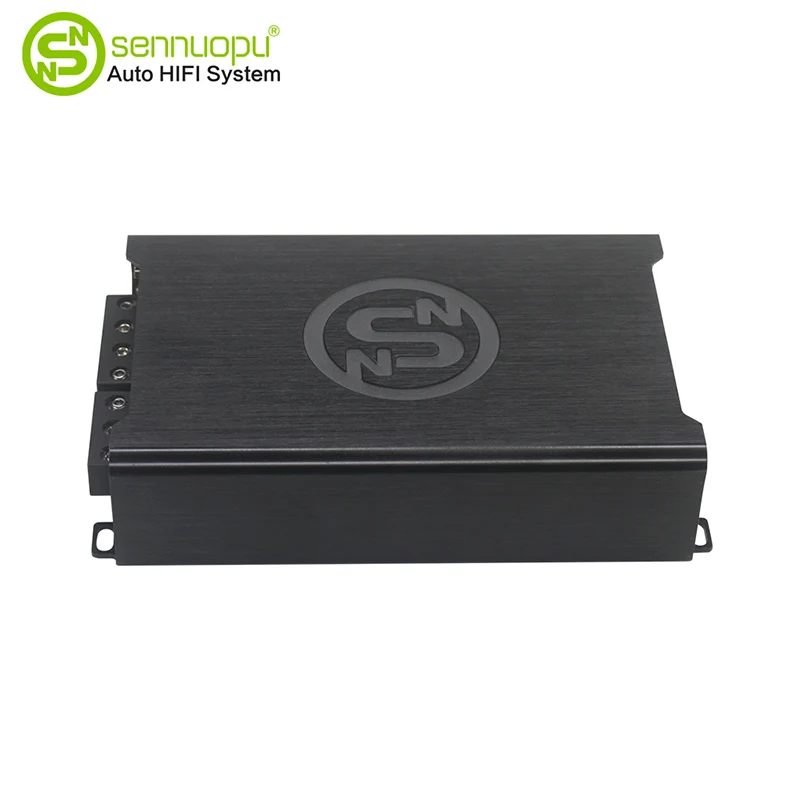
Understanding Power Ratings That Actually Matter
Not all wattage is created equal. When evaluating a Digital Car Audio Amplifier Full-Range Sound with Deep Bass, focus on RMS (continuous) power rather than peak ratings. Sennuopu publishes conservative, CTA-2006-compliant figures so you can compare apples to apples.
| Rating Type | What It Means | Why It Matters |
|---|---|---|
| RMS (Continuous) | Sustainable power over time | Determines real-world loudness and thermal safety |
| Peak / Max | Short burst capability | Marketing figure; not a reliable sizing metric |
| THD+N | Distortion at rated power | Lower is cleaner; look for <1% at full RMS |
| Damping Factor | Control over speaker motion | Higher values tighten bass response |
Matching Power to Your Goals
The table below offers practical starting points for a Digital Car Audio Amplifier Full-Range Sound with Deep Bass setup. These figures assume typical 4-ohm speakers and a well-damped enclosure.
| Listening Goal | Power per Channel (RMS) | Typical Configuration |
|---|---|---|
| Factory upgrade / casual listening | 25–50 W | 4-channel amp, stock speakers |
| Balanced daily driving | 50–75 W | 4-channel amp, component speakers |
| Dynamic, full-range performance | 75–100 W | 4-channel amp + subwoofer channel |
| Competition-level deep bass | 100–150 W+ | Multi-amp setup with dedicated sub stage |
For most enthusiasts seeking Full-Range Sound with Deep Bass, 75–100 W RMS per channel provides ample headroom. Headroom is critical: an amplifier running at 50% capacity delivers cleaner transients than one pushed to its limit. Sennuopu designs its amplifiers with generous power supplies to maintain output during dynamic peaks.
The Role of Deep Bass in Power Planning
Bass frequencies demand far more energy than mids and highs. Every 3 dB increase in output requires double the power. A dedicated subwoofer channel—typically 200–500 W RMS—relieves the main channels and lets your Digital Car Audio Amplifier Full-Range Sound with Deep Bass operate efficiently. Sennuopu multi-channel amplifiers simplify this by integrating a high-current sub section alongside full-range channels.
Electrical System Considerations
Your alternator and battery must support total system draw. As a rule, every 100 W RMS requires roughly 8–10 amps of current. A 600 W system needs about 50–60 amps of headroom beyond factory loads. Upgrade the "big three" wiring and consider a Sennuopu power distribution solution before adding amplification.
FAQ
Q: How much RMS power do I need for a Digital Car Audio Amplifier Full-Range Sound with Deep Bass in a typical sedan?
A: For a typical sedan, 50–75 W RMS per channel drives component speakers to satisfying levels, while a dedicated 200–300 W RMS subwoofer channel delivers convincing deep bass. Total system power of 400–600 W RMS is a practical sweet spot. Choose a Sennuopu amplifier rated at or slightly above your speaker's continuous handling to preserve headroom and avoid clipping.
Q: Can too much power damage my speakers when using a Digital Car Audio Amplifier Full-Range Sound with Deep Bass?
A: Damage usually comes from under-powering (clipping) rather than clean excess power. A Digital Car Audio Amplifier Full-Range Sound with Deep Bass operating within its RMS limits produces clean signal; distortion arises when gains are set incorrectly or the amp is pushed beyond capacity. Match amplifier RMS to speaker RMS, set gains with a meter, and your Sennuopu system will run safely for years.
Q: Does a Digital Car Audio Amplifier Full-Range Sound with Deep Bass require a separate subwoofer amplifier?
A: Not necessarily. Many Sennuopu multi-channel amplifiers include a dedicated subwoofer channel with a low-pass filter, allowing one chassis to power full-range speakers and a sub simultaneously. This integration reduces wiring complexity, saves space, and ensures consistent tonal balance across the entire frequency spectrum.
Q: What gauge wiring supports a high-power Digital Car Audio Amplifier Full-Range Sound with Deep Bass?
A: For systems up to 600 W RMS, 4-gauge power wire is appropriate; above 1,000 W, use 1/0-gauge. Always fuse within 18 inches of the battery and ground to bare metal. Sennuopu recommends matching wire gauge to total current draw for safe, efficient operation.
Conclusion
Sizing power correctly is the difference between a system that sings and one that strains. Target 75–100 W RMS per channel for full-range performance, add a dedicated sub stage for deep bass, and respect your electrical system's limits. A Digital Car Audio Amplifier Full-Range Sound with Deep Bass from Sennuopu delivers the headroom, thermal stability, and tonal accuracy that demanding listeners expect.
Contact us today to speak with a Sennuopu audio specialist who can recommend the ideal amplifier configuration for your vehicle, or visit our product catalog to compare RMS ratings, channel configurations, and installation accessories.