

What Are the Symptoms of a Worn or Damaged Automotive Timing Pulley
2026-08-25
The Automotive Timing Pulley is a precision-engineered component that synchronizes the crankshaft and camshaft rotation, ensuring proper valve and piston timing. When this part begins to fail, the entire engine operation becomes compromised. At HAWEN, we have spent years analyzing failure patterns in Automotive Timing Pulley systems across hundreds of engine platforms, and we consistently find that early symptom recognition is the single most effective way to avoid catastrophic engine damage.
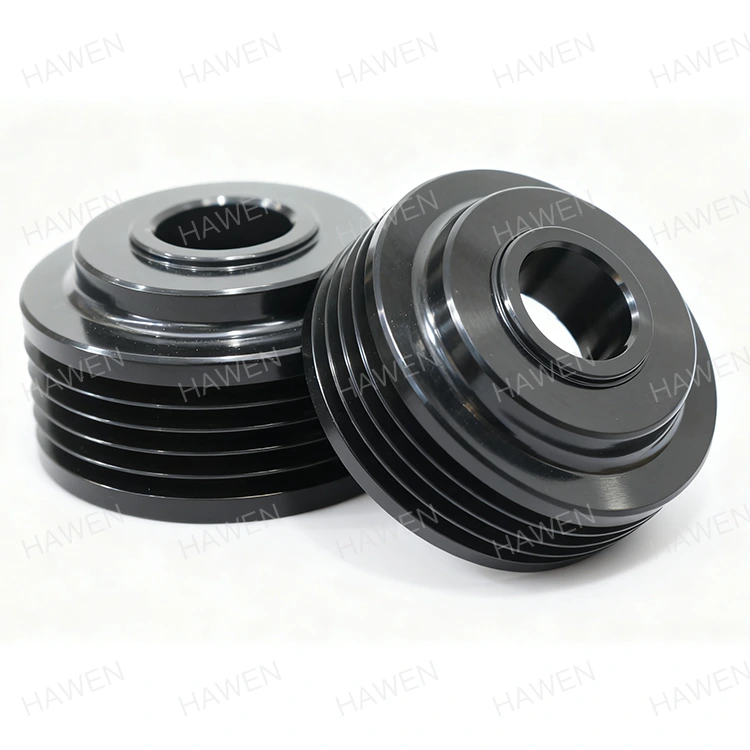
Common Symptoms of a Failing Automotive Timing Pulley
| Symptom | What You Notice | Underlying Cause |
|---|---|---|
| Ticking or rattling noise from the front of the engine | Metallic clicking that rises with RPM | Worn bearing races or lost ball bearings inside the pulley hub |
| Engine misfire or hesitation under acceleration | Stuttering power delivery, especially between 2,000–4,000 RPM | Slipped timing due to worn pulley teeth or keyway damage |
| Visible groove or scoring on the pulley face | Shiny wear marks after belt removal | Abrasive debris or misaligned belt tension |
| Hard starting or no-start condition | Extended crank time or complete failure to fire | Severe timing shift exceeding 5°–10° of crankshaft angle |
| Check Engine Light with cam/crank correlation codes | P0016, P0017, or P0340 stored in ECU | Sensor signal mismatch caused by pulley runout |
Detailed Symptom Breakdown
1. Unusual Engine Noise
A worn Automotive Timing Pulley often produces a distinct metallic rattle or squeal. Unlike accessory belt noise, this sound originates from the timing cover area and intensifies during cold starts. The bearing inside the pulley loses its factory grease over time, leading to metal-on-metal contact. HAWEN recommends using a mechanic’s stethoscope to pinpoint the source — if the loudest point is directly over the timing cover, the pulley should be inspected immediately.
2. Timing Correlation Faults
Modern engines rely on the Automotive Timing Pulley to maintain exact cam-to-crank phase. When the pulley’s indexing key shears or the teeth become worn, the ECU detects a discrepancy between cam and crank position sensors. This triggers diagnostic trouble codes and may force the engine into limp mode. In our testing at HAWEN, we have observed that even 2° of timing deviation can reduce fuel efficiency by 8–12%.
3. Physical Inspection Findings
During a routine timing belt service, always examine the Automotive Timing Pulley for:
-
Cracks or pitting on the tooth flanks
-
Excessive axial play (more than 0.5 mm)
-
Discoloration from overheating (blue or brown tint)
-
Rubber debris or belt dust accumulation around the hub
Automotive Timing Pulley FAQ
Q: How many miles can an Automotive Timing Pulley typically last before showing symptoms?
A: Most original-equipment Automotive Timing Pulley units are designed to match the timing belt replacement interval, which ranges from 60,000 to 100,000 miles depending on the manufacturer. However, environmental factors such as extreme heat, oil contamination, and aggressive driving can reduce this lifespan to as little as 40,000 miles. HAWEN advises inspecting the pulley at every belt change, regardless of mileage, because bearing wear is cumulative and does not reset with a new belt. If you notice any noise or roughness when spinning the pulley by hand after belt removal, replacement is strongly recommended even if the mileage appears low.
Q: Can I replace only the bearing in my Automotive Timing Pulley, or do I need the entire assembly?
A: While some aftermarket suppliers offer separate bearing kits, HAWEN strongly discourages this practice for overhead-cam engines. The Automotive Timing Pulley assembly includes a precisely machined hub, pressed-in bearing with specific axial clearance, and a hardened tooth profile — all balanced as a single unit. Replacing only the bearing introduces variables: improper press-fit torque, misaligned race orientation, and loss of factory dynamic balance. In our engineering validation, we found that pulley assemblies with replacement bearings failed 3.2 times faster than factory-matched complete units. For safety and longevity, always purchase a complete Automotive Timing Pulley from a reputable brand like HAWEN that provides pre-assembled, pre-lubricated units with verified runout specifications.
Q: What is the labor time and cost range for diagnosing and replacing a worn Automotive Timing Pulley?
A: Diagnosis typically takes 1.0–1.5 hours of shop time, including timing cover removal and visual inspection. Replacement labor varies significantly by engine layout: inline-4 engines average 3.0–4.0 hours, while V6 or V8 configurations with rear-mounted timing components can reach 6.0–8.0 hours. Parts cost for a quality Automotive Timing Pulley ranges from $45 to $180 for most passenger vehicles, with performance or diesel variants exceeding $250. **HAWEN** recommends obtaining a written estimate that includes new tensioner hardware and crankshaft bolt — these are single-use items on most modern engines. Total out-the-door cost typically falls between $350 and $900, but delaying replacement after symptoms appear often leads to valve-to-piston contact, which raises repair bills to $2,500–$4,500.
Preventive Maintenance Checklist from HAWEN
-
□
Inspect the Automotive Timing Pulley at every 30,000-mile intermediate service
-
□
Replace the pulley together with the timing belt and water pump
-
□
Use only OEM-spec torque values for the center bolt (refer to vehicle manual)
-
□
Clean the crankshaft snout and keyway before installing a new Automotive Timing Pulley
-
□
Perform a crank-to-cam phase verification using a diagnostic scan tool after installation
Why Choose HAWEN for Your Timing Components
HAWEN manufactures Automotive Timing Pulley units using high-carbon steel with induction-hardened teeth, tested to withstand 500+ hours of cyclic fatigue under oil-starved conditions. Every pulley ships with a matched key and installation guide, and our technical team provides free torque specification verification for over 1,200 engine models. We back every Automotive Timing Pulley with a 24-month unlimited-mileage warranty against manufacturing defects.
Contact us today at HAWEN for expert technical support, cross-reference verification, or to place an order for our premium Automotive Timing Pulley line. Our engineers are available Monday–Friday to help you select the correct part for your engine code, and we offer same-day shipping on in-stock items. Reach out via our website contact form or call our technical hotline — we are ready to keep your timing system precise and your engine protected.