

What Challenges Do Sprayer Robots Face in Unever Terrain Navigation
2026-02-28
The integration of advanced robotics into agriculture and industrial maintenance has brought the Sprayer Robot to the forefront of modern efficiency. However, the operational effectiveness of these machines is heavily tested when they leave the flat, prepared surfaces of warehouses or manicured lawns. For a brand like Luckyram, engineering a Sprayer Robot that conquers rugged landscapes involves overcoming a complex set of engineering and software challenges. Understanding these obstacles is key to appreciating the technology that ensures precise application and autonomous safety in the field.
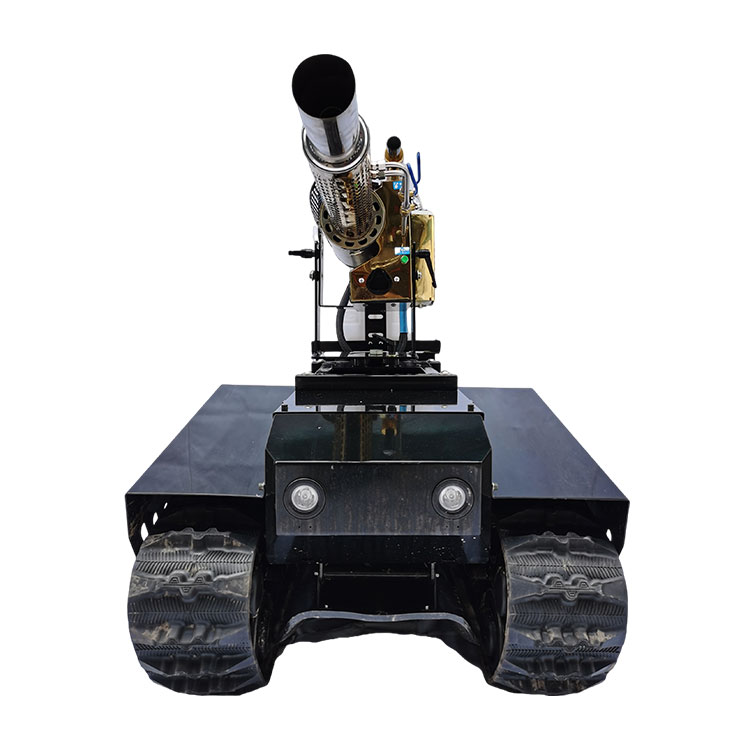
Primary Terrain Navigation Obstacles
When a Sprayer Robot moves from a concrete floor to a muddy vineyard or a rocky construction site, several physical and computational issues arise. The following table outlines the primary challenges and their direct impact on performance.
| Challenge Category | Specific Issue | Impact on Sprayer Robot Operation |
|---|---|---|
| Traction & Mobility | Slippery mud, loose gravel, or steep inclines | Causes wheel slippage, loss of stability, and inability to maintain a straight path, leading to uneven spray coverage. |
| Sensor Accuracy | Bumpy ground causing excessive vibration | Disrupts LiDAR and camera sensors, creating "noisy" data that confuses the robot's perception of its surroundings. |
| Chassis Dynamics | Side slopes and abrupt bumps | Increases the risk of tipping over, especially when the liquid tank is full and the center of gravity shifts dramatically. |
| Power Management | High-resistance surfaces (thick grass, sand) | Demands higher torque and energy consumption, significantly reducing the operational battery life of the Sprayer Robot. |
| Precision Application | Fluctuating distance between nozzle and crop/ground | Maintain a consistent spray pattern is difficult; the robot must constantly adjust boom height or nozzle pressure in real-time. |
Engineering Solutions for Rugged Fields
To address the instability caused by uneven terrain, Luckyram integrates specific design philosophies that prioritize both mobility and intelligence. A simple comparison highlights how advanced features differ from standard capabilities.
| Feature | Standard Function | Luckyram Advanced Function for Terrain |
|---|---|---|
| Suspension | Rigid chassis, prone to tipping | Independent articulated suspension allowing each wheel to maintain ground contact |
| Localization | GPS only (fails in valleys or tree cover) | Sensor fusion combining RTK-GPS, IMU (Inertial Measurement Unit), and visual odometry |
| Obstacle Detection | 2D LiDAR (flat scanning) | 3D multi-plane LiDAR to detect ditches, rocks, and sudden drops |
| Spray Mechanism | Fixed boom | Active suspension on booms to keep nozzles level relative to the ground |
Frequently Asked Questions About Terrain Navigation
Q: How does a Sprayer Robot maintain its balance on a steep slope without tipping over?
A: Maintaining stability on an incline requires a combination of mechanical design and real-time software adjustments. High-end Sprayer Robot models, such as those developed by Luckyram, utilize a low center of gravity chassis and advanced algorithms that monitor the pitch and roll of the machine hundreds of times per second. If the angle becomes critical, the system automatically slows the drive motors, adjusts the trajectory away from the slope direction, and can temporarily reduce spray output to prevent the liquid sloshing, which further destabilizes the robot. This dynamic stability control ensures the robot can safely traverse contours that would be dangerous for static or simpler machines.
Q: Can a Sprayer Robot accurately navigate a field where the GPS signal is weak due to trees or mountains?
A: Yes, a sophisticated Sprayer Robot does not rely solely on GPS. In environments with significant canopy cover or near terrain features that block satellite signals, the robot switches to a multi-sensor fusion mode. Luckyram robots, for instance, combine the intermittent GPS data with continuous input from an Inertial Measurement Unit (IMU) that tracks acceleration and rotation, and visual odometry from cameras that track ground features like rocks or plant rows. By comparing these data points against a pre-loaded map of the terrain, the robot can effectively "dead reckon" its position accurately through dead zones until the GPS signal is reacquired.
Q: What happens if the Sprayer Robot encounters a deep rut or a large rock that it cannot drive over?
A: Upon encountering an insurmountable obstacle, the Sprayer Robot's behavior is dictated by its programming for the specific task. Initially, the 3D sensing system identifies the object as an impassable hazard. The robot will then attempt to pathfind around it by referencing its terrain map. If no viable path exists—for example, if a rut is too wide or a rock creates a dangerous angle—the Sprayer Robot will execute a safe stop protocol. It will log the precise location of the obstacle, retrace its path slightly to a safe location, and send an alert to the operator via a management platform. This ensures the machine does not damage itself and alerts the farmer to a field hazard that might need physical removal or manual intervention.
Conclusion
Navigating uneven terrain is the ultimate test of a Sprayer Robot's durability and intelligence. From maintaining traction on slippery slopes to ensuring sensor accuracy amidst vibration, the challenges are significant but solvable through innovative engineering. Luckyram is committed to developing autonomous solutions that bring precision and reliability to the most demanding outdoor environments.
Is your operation ready to overcome the challenges of difficult terrain? Explore our range of rugged autonomous platforms today.
Contact Us to schedule a demonstration and see how Luckyram can optimize your spraying operations.