

What Speakers Match Best with a Car DSP Amplifier 6*110 W and 31 Band Equalizer
2026-10-20
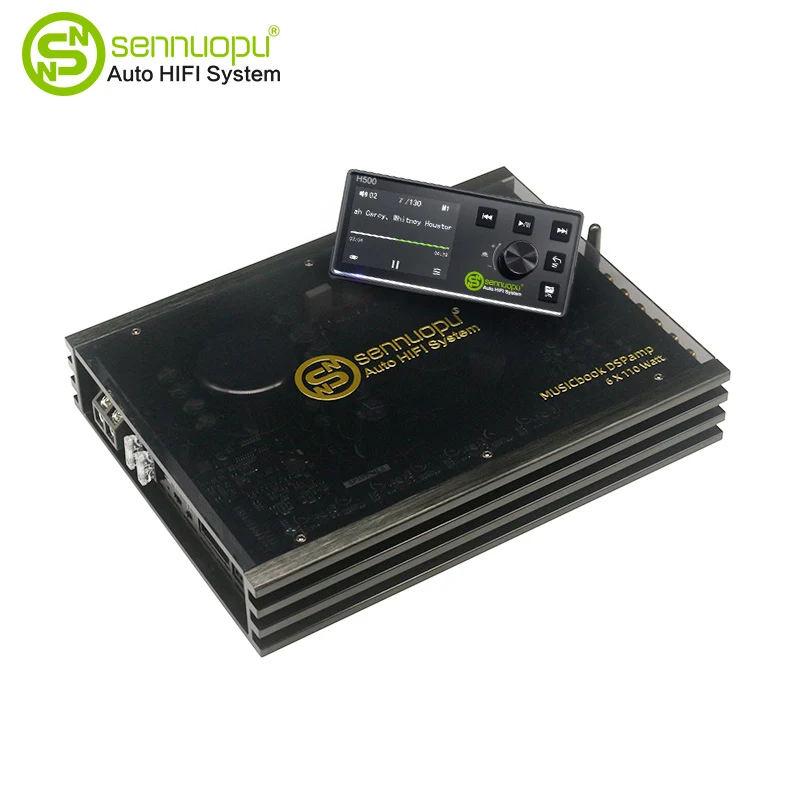
Choosing the right speakers for a Car DSP Amplifier 6*110 W 31 Band Equalizer is one of the most consequential decisions in any upgrade. Sennuopu engineers regularly test amplifier-speaker combinations, and the results show that matching impedance, power handling, and sensitivity to the amplifier's six channels delivers cleaner output and far more precise tuning than buying speakers on price alone.
Why the 6×110 W Architecture Changes Speaker Selection
A Car DSP Amplifier 6*110 W 31 Band Equalizer provides six independent amplified channels, each rated at 110 W. That configuration supports active front-stage setups, rear fill, and a subwoofer channel without external crossovers. Because the DSP offers 31 bands of equalization per channel, speakers with flat, predictable frequency response benefit most—the equalizer corrects acoustics, not driver defects.
Key Matching Criteria
| Criterion | Recommended Target | Why It Matters |
|---|---|---|
| Impedance | 4 Ω nominal (2 Ω stable) | Protects the amplifier and preserves rated output |
| RMS power handling | 80–150 W per channel | Headroom prevents clipping at high volume |
| Sensitivity | 88–92 dB (1 W/1 m) | Efficient output with minimal distortion |
| Frequency response | 60 Hz–20 kHz (component sets) | Supports smooth 31-band correction |
| Crossover capability | Active-capable components | Enables per-channel DSP tuning |
Recommended Speaker Configurations
-
Front stage: 6.5-inch two-way component sets, 100 W RMS, 4 Ω—ideal for active bi-amping across four channels.
-
Rear fill: Coaxial speakers, 60–80 W RMS, attenuated in the DSP for ambiance rather than volume.
-
Subwoofer: 4 Ω single-voice-coil or 2 Ω dual-voice-coil sub, 250–400 W RMS, bridged or dedicated channel.
-
Avoid: High-impedance (8 Ω) drivers that waste the amplifier's output, and low-sensitivity drivers that demand excessive gain.
Sennuopu Tuning Notes
Sennuopu recommends setting gains with a test tone before engaging the 31-band equalizer, then applying gentle cuts rather than aggressive boosts. Time alignment should follow speaker placement, and crossover points should sit at least one octave from driver limits.
FAQ
Q: Can a Car DSP Amplifier 6*110 W 31 Band Equalizer power a subwoofer directly?
A: Yes, provided the subwoofer's impedance and RMS rating fall within the amplifier's per-channel limits—typically a 4 Ω sub up to 150 W RMS, or a bridged pair of channels for higher output.
Q: Do I need component speakers or coaxials with a Car DSP Amplifier 6*110 W 31 Band Equalizer?
A: Component speakers are strongly preferred for the front stage because separate tweeters and midbass drivers allow independent equalization and time alignment across the DSP's channels.
Q: What impedance is safest for a Car DSP Amplifier 6*110 W 31 Band Equalizer?
A: 4 Ω nominal per channel is the safest and most common choice; 2 Ω loads are acceptable only if the manufacturer explicitly rates the amplifier for them.
Q: How much power headroom should speakers have with this amplifier?
A: Choose speakers rated 20–40% above the amplifier's 110 W per-channel output so transients reproduce cleanly without compression or distortion.
Matching speakers correctly unlocks the full potential of a Car DSP Amplifier 6*110 W 31 Band Equalizer, and Sennuopu supports every configuration with documented specifications and tuning guidance. Contact us today to request a personalized speaker-matching recommendation for your vehicle and audio goals.