

Which Speakers and Subwoofers Pair Best with a 16-Channel Hi-Res Digital Sound Processor with 14 Channel Amplifier
2026-10-09
Building a truly immersive car audio system starts with choosing the right processing and amplification backbone. A 16-Channel Hi-Res Digital Sound Processor with 14 Channel Amplifier from Sennuopu gives you extraordinary tuning flexibility, but its final sound signature depends heavily on the speakers and subwoofers you connect to it. This guide breaks down matching strategies, power requirements, and real-world pairings so you can build a system that sounds as good as it measures.
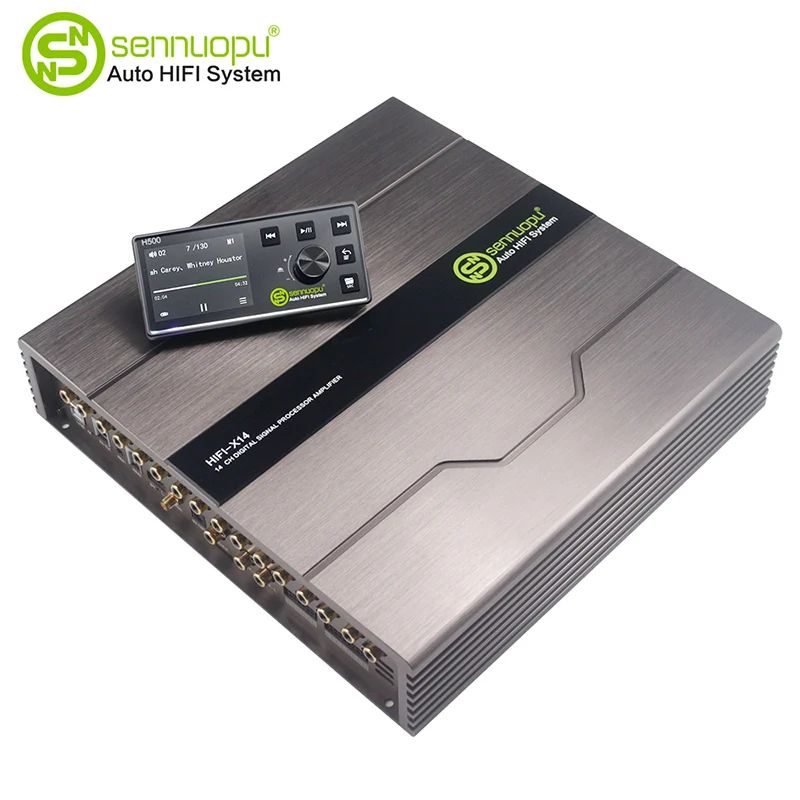
Understanding the Platform First
Before selecting drivers, you need to understand what this processor-amplifier platform offers:
| Feature | Why It Matters for Speaker Matching |
|---|---|
| 16 processing channels | Supports active multi-way systems without passive crossovers |
| 14 amplified channels | Allows direct drive of tweeters, mids, midbass, and subwoofers |
| Hi-Res audio support | Demands drivers with low distortion and wide frequency response |
| DSP tuning per channel | Lets you correct driver weaknesses and room acoustics |
| High-resolution DAC | Reveals detail that entry-level speakers cannot reproduce |
Because the 16-Channel Hi-Res Digital Sound Processor with 14 Channel Amplifier is so capable, budget coaxial speakers often become the bottleneck. The goal is to match resolution with resolution.
Key Matching Criteria
Use these five criteria before buying any driver:
-
Power handling — Each amplified channel on the Sennuopu unit delivers usable RMS power, so choose components rated within that range for headroom and safety.
-
Impedance stability — Confirm whether your configuration runs at 2, 4, or 8 ohms per channel, and verify the amplifier remains stable.
-
Frequency response — Hi-Res playback benefits from tweeters reaching beyond 20 kHz and midbass drivers performing cleanly down to 60–80 Hz.
-
Sensitivity — Higher sensitivity (90 dB and above) preserves dynamic range and reduces strain on the amplifier.
-
Active-capable design — Components with smooth off-axis response and flexible crossover points work best in active setups.
Recommended Speaker Pairings
| System Style | Recommended Speaker Type | Recommended Subwoofer Type | Why It Works |
|---|---|---|---|
| SQ-focused 3-way front stage | 1" silk dome tweeters, 3" midrange, 7" midbass | Sealed 10" or 12" subwoofer | Delivers precise staging and natural tonality |
| High-output 2-way active | 1" titanium tweeters, 6.5" midbass | Ported 12" subwoofer | Strong dynamics for rock and electronic music |
| SQL daily driver | 1" tweeters, 6.5" components | Sealed 10" shallow-mount subwoofer | Balanced output with tight, accurate bass |
| Competition-grade build | 3-way active front stage | Dual sealed 12" subwoofers | Maximum control, detail, and low-end authority |
For most enthusiasts running the 16-Channel Hi-Res Digital Sound Processor with 14 Channel Amplifier, a 3-way active front stage plus a single high-quality subwoofer delivers the best balance of cost, complexity, and performance.
Subwoofer Selection Tips
-
Sealed enclosures favor accuracy and integrate smoothly with the DSP's time alignment.
-
Ported enclosures produce more output but require careful tuning below 40 Hz.
-
Subwoofer impedance should match the bridged or dedicated channel configuration.
-
Power rating should sit comfortably within the amplifier's rated output to avoid clipping.
FAQ
Q: Can a 16-Channel Hi-Res Digital Sound Processor with 14 Channel Amplifier run a fully active 3-way front stage plus a subwoofer?
A: Yes. With 16 processing channels and 14 amplified channels, the Sennuopu unit can independently drive tweeters, midranges, midbass drivers, and subwoofers while leaving spare channels for rear fill or center channels.
Q: What impedance should my speakers be for the 16-Channel Hi-Res Digital Sound Processor with 14 Channel Amplifier?
A: Most installations work best with 4-ohm components, though 2-ohm stable configurations are possible. Always confirm the minimum impedance rating for each channel before wiring.
Q: Do I need high-end speakers to benefit from the 16-Channel Hi-Res Digital Sound Processor with 14 Channel Amplifier?
A: Yes, to fully realize its resolution. Entry-level speakers may mask detail, while quality components with low distortion and wide frequency response reveal the true capability of the Sennuopu platform.
Final Thoughts
Pairing the right speakers and subwoofers with a 16-Channel Hi-Res Digital Sound Processor with 14 Channel Amplifier is about matching resolution, power, and tuning flexibility. Choose components that can keep up with the processor's clarity, and you will unlock a soundstage with depth, precision, and impact.
Ready to design your ideal system? Contact us today for expert guidance on matching Sennuopu processing and amplification with the perfect speakers and subwoofers for your vehicle.