

Why Belt Pulleys with standard grooves prevent belt slippage effectively?
2026-09-01
Belt slippage is not just a performance issue—it is a safety issue. In industrial applications ranging from conveyor systems to power transmission, a slipping belt means lost torque, heat generation, and unpredictable downtime. The geometry of the Belt Pulley groove is the single most important factor in preventing slippage. But why does a standard groove work so well, while a non standard or worn groove fails? The answer is in the physics of friction, contact angle, and load distribution. This article analyzes the engineering principles behind groove design and explains how correct pulley geometry ensures reliable power transmission.
1. What Is the Mechanical Relationship Between Groove Angle and Belt Friction?
The friction between a V belt and its Belt Pulley depends on the wedge effect created by the groove. The deeper the belt sits in the groove, the more friction is generated for the same amount of tension. The standard groove angle for a classic V belt is 40 degrees. This angle is not arbitrary. It is calculated to create an optimum wedge effect while still allowing the belt to release when the load decreases. At 40 degrees, the belt engages with about 50 to 70 percent of its side surface, depending on the belt's compression modulus. This engagement creates a normal force that is higher than the tension force alone would produce. In our factory, we manufacture Belt Pulleys with precision machined grooves that maintain the 40 degree angle within a tolerance of ±0.5 degrees. This precision ensures that the belt is gripped consistently around the entire circumference. A deviation of 2 degrees in the groove angle can reduce the friction coefficient by up to 30 percent, leading to premature slipping. At Zhejiang Hawen Electromechanical Co., Ltd., we use CNC machining to maintain this critical dimension.
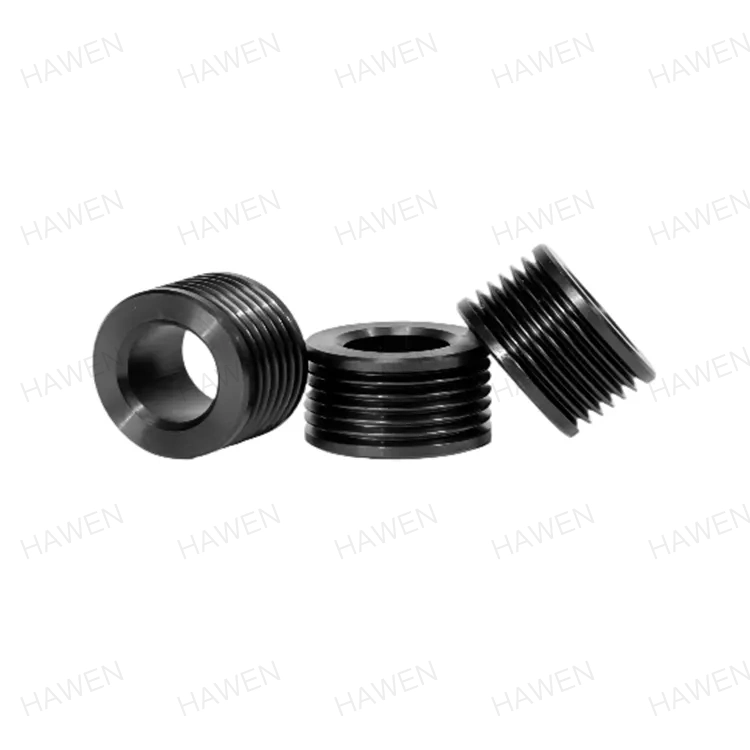
2. Why Does the Standard Groove Depth Prevent the Belt from Bottoming Out?
A belt that sits too deep in the groove is not gripping the sides—it is riding on the bottom of the pulley. This destroys the wedge effect and allows the belt to slip. Conversely, a belt that sits too high only contacts the top edges of the groove, which also reduces friction. The standard groove depth is designed so that the belt's outer surface is flush with the pulley outer diameter when the belt is properly tensioned. This ensures that the belt makes contact with the full side profile of the groove. In our factory, we produce Belt Pulleys with grooves that conform to the RMA (Rubber Manufacturers Association) and DIN 2211 standards. These standards specify the groove depth based on the belt's top width and the angle. The table below shows the relationship between belt size and the recommended groove dimensions.
| Belt section | Groove angle (degrees) | Groove depth (mm) | Top width of belt (mm) | Minimum pulley diameter (mm) |
| A | 40 | 10.0 | 13.0 | 75 |
| B | 40 | 11.0 | 17.0 | 125 |
| C | 40 | 14.0 | 22.0 | 200 |
| D | 40 | 19.0 | 32.0 | 355 |
| SPA | 40 | 11.0 | 13.0 | 90 |
When a Belt Pulley is manufactured to these standard dimensions, the belt and pulley work as a matched system. When components from different suppliers are mixed, the depth and angle often do not match, leading to accelerated belt wear and eventual slippage.
3. How Does Surface Finish and Groove Condition Affect Slip Resistance?
Even with correct geometry, a smooth groove surface can cause belt slip. The friction coefficient between a rubber belt and a metal pulley is typically between 0.3 and 0.5. This coefficient is significantly affected by the surface roughness of the groove. Our factory uses a surface finish of 3.2 Ra for standard applications. This roughness provides enough grip without causing excessive belt wear. If the groove is too smooth (below 1.6 Ra), the belt can slip under peak loads. If it is too rough (above 6.3 Ra), the belt will wear out quickly. We also apply a phosphate coating on our Belt Pulleys to improve initial grip and to protect against rust. In field conditions, the most common cause of reduced friction is glazing of the groove surface. This happens when the belt slips repeatedly, generating heat that polishes the groove. Regular inspection of the groove surface can catch this problem before it leads to a catastrophic slip. The table below compares the performance of Belt Pulleys with different surface conditions in a standard load test.
| Groove condition | Surface roughness (Ra) | Friction coefficient (measured) | Slip onset load (Nm) | Belt wear rate |
| Standard machined (our product) | 3.2 | 0.42 | 185 | Baseline (1x) |
| Polished (worn groove) | 1.2 | 0.28 | 120 | 0.8x (less wear but slips) |
| Rough cast (no finishing) | 8.0 | 0.48 | 195 | 2.5x (high wear) |
| With phosphate coating | 3.2 | 0.50 | 205 | 0.9x |
Our Belt Pulleys are also dynamically balanced to reduce vibration, which can cause intermittent micro slip that gradually widens the groove. Maintaining the correct groove condition is essential for maximizing the life of both the pulley and the belt.
4. What Happens When the Groove Profile Deviates from the Standard?
Deviations in groove profile are often caused by wear, improper manufacturing, or mismatched components. The most common deviations are: reduced groove angle (too narrow), increased groove angle (too wide), and uneven groove depth across the pulley. Each of these conditions reduces the contact area between the belt and the pulley. A worn pulley with a widened groove will cause the belt to sit lower in the groove, losing the wedge effect. An uneven depth across the pulley will cause the belt to run at an angle, creating uneven loading and vibration. In our factory, we manufacture Belt Pulleys with a pitch diameter tolerance of ±0.05 mm. This ensures that the groove profile is consistent around the entire circumference. We also use a go no go gauge to check the groove angle and depth on every production batch. This is a critical control point because even a small deviation can cause the belt to slip under high torque. At Hawen, we have documented that pulleys produced to this tolerance maintain their grip for more than 10,000 operating hours, whereas pulleys with out of spec grooves begin to show slip within 1,000 hours.
Frequently Asked Questions About Belt Pulley Grooves and Slippage
Final Summary
The effectiveness of a Belt Pulley in preventing slippage is determined by the groove geometry, surface finish, and the consistency of these parameters across the entire pulley circumference. Standard grooves have been optimized over decades to provide the best balance between grip, belt life, and manufacturing cost. Using a pulley that deviates from these standards introduces unnecessary risk. Our factory manufactures Belt Pulleys that meet or exceed all major international standards, ensuring reliable power transmission in your application. Zhejiang Hawen Electromechanical Co., Ltd. has been a trusted supplier to the industrial sector for over 15 years.