

Why Is Modified ABS Plastic Used in Land Rover Parts Production?
2026-10-08
In our factory, we have analyzed failed Land Rover Parts returned from the field for over a decade. The pattern is consistent: the parts that fail early are almost always made from standard ABS. The parts that survive five years or more are made from modified ABS. Standard ABS is a commodity plastic. It is inexpensive, easy to mold, and has good mechanical properties at room temperature. But it is vulnerable to ultraviolet radiation and to low-temperature impact. Under the combined effect of sunlight and temperature cycling, standard ABS yellows, becomes brittle, and eventually cracks. Modified ABS addresses these weaknesses through the addition of impact modifiers, UV stabilizers, and heat stabilizers. This guide explains what makes modified ABS suitable for Land Rover Parts and how to specify the right grade for each application.
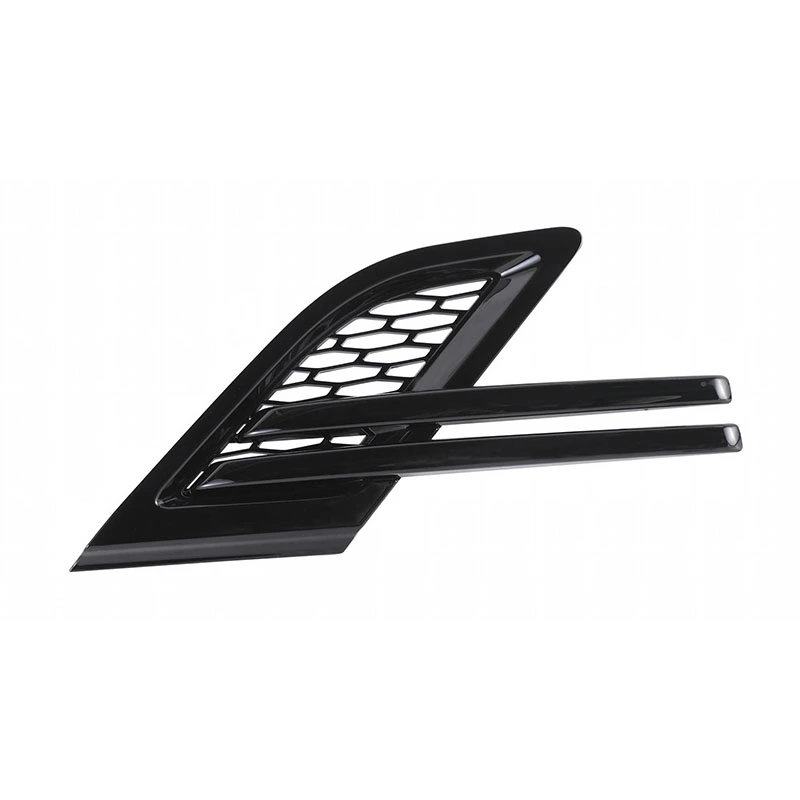
1. What Are the Failure Modes of Standard ABS in Land Rover Parts?
Standard ABS fails in three ways when used in automotive exterior and interior applications. The first is UV degradation. The butadiene rubber phase in ABS is attacked by ultraviolet radiation. The double bonds in the polybutadiene are oxidized, which causes chain scission and cross-linking. The result is a loss of impact strength and a change in color. The second is low-temperature embrittlement. The glass transition temperature of the polybutadiene phase is approximately -80°C, but the rubber phase loses its flexibility at low temperatures. At -30°C, standard ABS becomes brittle and can crack under impact. The third is thermal oxidation. At elevated temperatures, the polymer chains degrade, which causes yellowing and a loss of mechanical properties. The table below shows the property changes of standard ABS after accelerated aging.
| Property | Initial value | After 1,000 hours QUV | After 1,000 hours at 90°C |
| Tensile strength (MPa) | 42 | 38 | 36 |
| Impact strength (kJ/m²) | 25 | 12 | 15 |
| Color change (ΔE) | 0 | 8 – 12 | 5 – 8 |
| Surface appearance | Glossy | Chalky, yellowed | Yellowed |
The impact strength drops by more than 50 percent after 1,000 hours of QUV exposure. The color change is visible to the naked eye. In our factory, we have seen standard ABS Land Rover Parts develop surface cracks within two years of service in sunny climates. Zhejiang Aori Auto Parts Co., Ltd. has been producing modified ABS components for over 12 years.
2. How Does Rubber Modification Improve Impact Strength?
Modified ABS contains a higher concentration of rubber phase, typically 15 to 25 percent, compared to 5 to 10 percent in standard ABS. The rubber particles are grafted with styrene-acrylonitrile copolymer, which improves compatibility with the matrix. When the material is impacted, the rubber particles absorb energy by cavitation and shear yielding. This prevents crack propagation. The table below shows the effect of rubber content on impact strength at different temperatures.
| Rubber content | Impact strength at 23°C (kJ/m²) | Impact strength at -20°C (kJ/m²) | Impact strength at -30°C (kJ/m²) |
| 5% (standard ABS) | 25 | 8 | 5 |
| 10% | 35 | 15 | 10 |
| 15% | 45 | 22 | 15 |
| 20% | 55 | 30 | 22 |
| 25% | 60 | 35 | 28 |
At -30°C, standard ABS has an impact strength of only 5 kJ/m². A modified grade with 20 percent rubber content has an impact strength of 22 kJ/m², which is more than four times higher. This is why modified ABS is used for Land Rover Parts that are exposed to cold climates, such as wheel arch extensions and bumper trim. In our factory, we use modified ABS with 15 to 20 percent rubber content for exterior components. Zhejiang Aori Auto Parts Co., Ltd. tests the impact strength of every batch at -30°C to verify the low-temperature performance.
3. How Do UV Stabilizers Prevent Yellowing and Chalking?
UV stabilizers are added to modified ABS to protect the butadiene phase from ultraviolet attack. There are two types of stabilizers: UV absorbers and hindered amine light stabilizers. UV absorbers absorb the ultraviolet radiation and convert it to heat. Hindered amine light stabilizers trap the free radicals that are formed during oxidation. The combination of both types provides synergistic protection. The table below shows the effect of stabilizer type on color change after QUV exposure.
| Stabilizer system | Color change (ΔE) after 1,000 hours | Impact strength retention after 1,000 hours | Typical loading |
| None | 12 | 45% | 0% |
| UV absorber only | 6 | 65% | 0.3 – 0.5% |
| HALS only | 5 | 70% | 0.3 – 0.5% |
| UV absorber + HALS | 2 | 85% | 0.5 – 0.8% total |
The combination of UV absorber and HALS reduces the color change from 12 to 2 and maintains 85 percent of the impact strength after 1,000 hours. This is the system we use in our modified ABS for Land Rover Parts. In our factory, we verify the UV performance by exposing samples to QUV for 2,000 hours and measuring the color change and impact strength. Zhejiang Aori Auto Parts Co., Ltd. provides UV test reports with every batch of modified ABS components.
4. What Are the Different Modified ABS Grades for Different Land Rover Parts?
Not all Land Rover Parts require the same grade of modified ABS. The selection depends on the exposure conditions and the mechanical requirements. Interior parts are protected from direct sunlight but must resist scratches and cleaning chemicals. Exterior parts are exposed to UV, temperature cycling, and impact. Structural parts must carry loads. The table below shows the recommended grades for different applications.
| Application | Rubber content | UV stabilizer | Special additive |
| Interior trim (door panels, console) | 10 – 15% | Low (0.2%) | Scratch resistance |
| Exterior trim (wheel arch, bumper) | 15 – 20% | High (0.6%) | Weathering resistance |
| Grille and front fascia | 20 – 25% | Very high (0.8%) | High flow for thin walls |
| Under hood components | 15 – 20% | Medium (0.4%) | Heat stabilizer |
| Structural brackets | 10 – 15% | Low (0.2%) | Glass fiber reinforcement |
Material selection tip: For Land Rover Parts that are exposed to both UV and low-temperature impact, specify a modified ABS with 20 percent rubber content and a combined UV absorber/HALS system. This grade provides the best balance of impact strength and weathering resistance. In our factory, we can provide a material data sheet for each grade, including the UV test results and the low-temperature impact data.
Frequently Asked Questions About Modified ABS in Land Rover Parts
Summary for Material Engineers and Sourcing Managers
Modified ABS is used in Land Rover Parts production because it addresses the failure modes of standard ABS. The higher rubber content improves low-temperature impact strength. The UV stabilizer system prevents yellowing and chalking. The heat stabilizer prevents thermal oxidation. By selecting the right grade for each application, engineers can ensure that the parts survive the combined effects of sunlight, temperature cycling, and mechanical load. Zhejiang Aori Auto Parts Co., Ltd. has been producing modified ABS components for over 12 years and provides full material data and test reports for our customers.
Zhejiang Aori Auto Parts Co., Ltd. manufactures Land Rover Parts from modified ABS with 10 to 25 percent rubber content and UV stabilizer systems. We provide material certificates, UV test reports, and low-temperature impact data for all of our products.